



Fast Charger vs GaN Charger: Key Differences Explained
What is the difference between a fast charger and a GaN charger?
A “fast charger” describes what a charger can do: deliver higher power so compatible devices charge more quickly. A “GaN charger” describes what a charger is made with: gallium nitride components that can make the charger smaller, cooler, and more efficient than many traditional silicon designs. In other words, fast charging is a capability, while GaN is a technology that can enable a better charger design.
Fast charger: a performance label
A fast charger supports one or more fast-charging standards (most commonly USB Power Delivery for USB-C, and sometimes Quick Charge for certain devices). The key idea is higher wattage and smart negotiation between the charger and device. For example, a phone might pull 18–30W, while a laptop may request 45–100W. If the charger and cable can’t support the needed standard or wattage, charging may be slower even if the charger is labeled “fast.”
GaN charger: a hardware upgrade
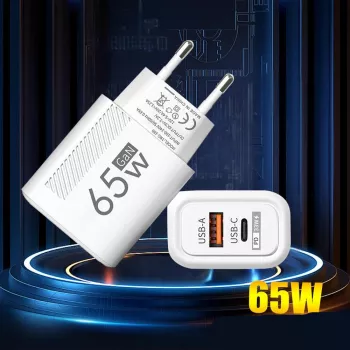
GaN chargers use gallium nitride transistors that switch efficiently at high frequencies. That efficiency can reduce energy loss as heat, which often allows manufacturers to build smaller, lighter chargers at the same power level. Many modern compact 65W USB-C laptop chargers are GaN-based because it’s an effective way to pack more power into a travel-friendly size.
How they overlap (and how they don’t)
A charger can be fast without being GaN (a larger silicon charger can still output high wattage). A charger can also be GaN without feeling “fast” for your device if its wattage is low or it doesn’t support the right protocol. The best choice depends on what you’re charging: match the charger’s USB-C PD profile (and wattage) to your device, then consider GaN for a more compact, cooler-running option.
For a deeper look at 65W GaN USB-C chargers, USB PD, and Quick Charge compatibility, see the full guide: https://havencia.com/blog/guide-65w-gan-usb-c-charger-quick-charge-usb-pd/.
FAQ
Do GaN chargers charge devices faster?
Only if they provide the wattage and charging standard your device can use. GaN mainly improves efficiency and size; speed still depends on USB PD/Quick Charge support, wattage, and your device’s limits.













Leave a comment