



5-in-1 Clutter-Free Kitchen Kit for Tiny Spaces
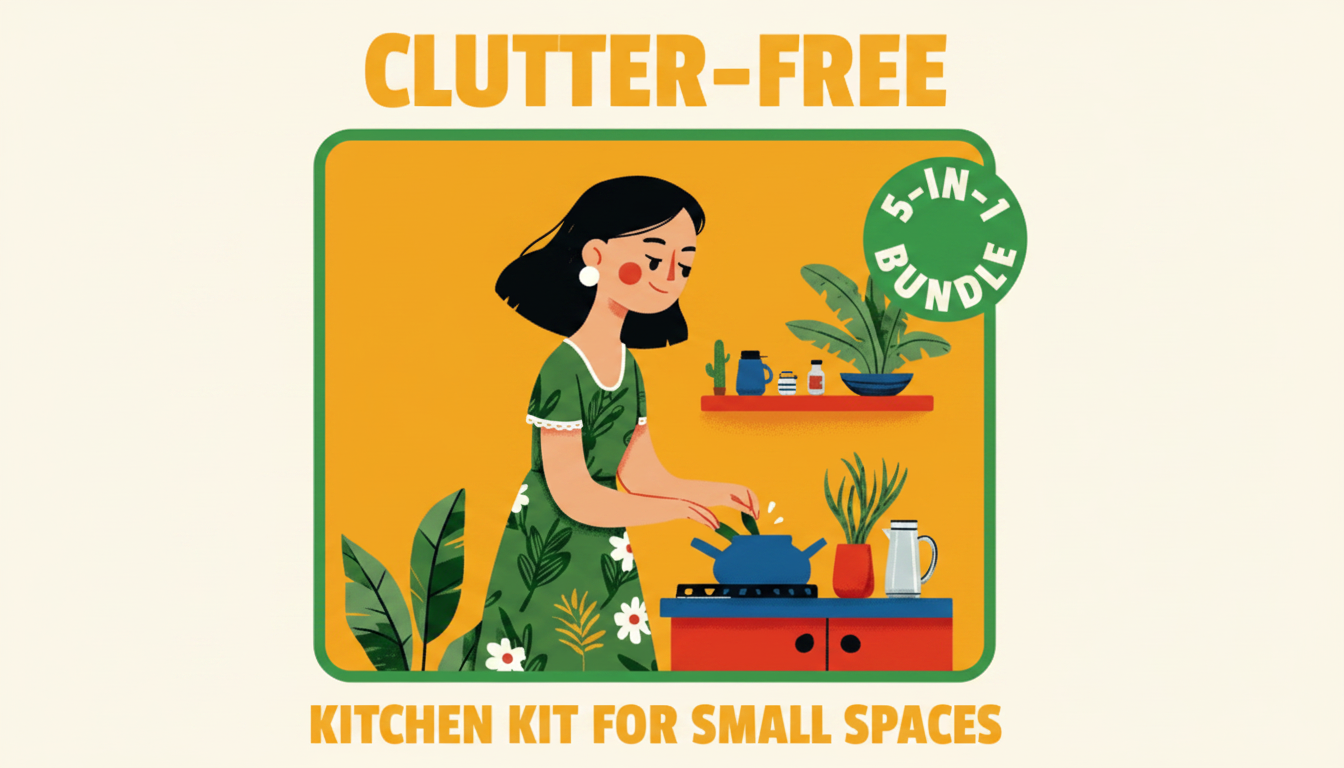
Clutter-Free Kitchen Kit for Small Spaces: A 5-in-1 Digital Bundle to Make a Tiny Kitchen Work Smarter
Small kitchens feel crowded fast: a few extra gadgets on the counter, a jammed drawer, or an overstuffed pantry can turn everyday cooking into constant searching and reshuffling. A simple system—clear zones, fewer duplicates, and quick reset routines—can make even a tiny kitchen feel calm. This digital bundle is designed to guide that process with printable tools that help decide what stays, where it lives, and how to keep it that way.
What “clutter-free” looks like in a small kitchen
A clutter-free tiny kitchen isn’t minimalist for the sake of it—it’s practical. The goal is to protect prep space and make daily cooking feel automatic instead of chaotic.
- Counters stay mostly open so prep is always possible without moving items first.
- Every category has a home: cooking tools, food storage, pantry staples, cleaning supplies.
- Daily-use items are reachable with one hand; occasional items are stored higher or deeper.
- A 5-minute reset can return the space to baseline after cooking.
- Duplicates and “maybe someday” items are minimized to protect drawer and cabinet space.
Why clutter returns in tiny kitchens (and how to stop the cycle)
Most kitchens get messy for the same reasons: unclear “homes,” hidden storage that invites duplicates, and no simple routine to keep the system intact. Fixing it doesn’t require buying more organizers—it requires making decisions once, then maintaining them in small, repeatable ways.
- No defined zones: when items can go anywhere, they end up everywhere.
- Overbuying staples: pantry overflow creates counter piles and cabinet avalanches.
- Too many one-use tools: specialty gadgets crowd out the basics.
- Hidden storage: deep cabinets become “forgotten item” zones that attract duplicates.
- No reset routine: even a good organization job drifts without a simple weekly check-in.
Common clutter triggers and quick fixes
| Trigger | What it causes | Quick fix for small spaces |
|---|---|---|
| Mail and papers on counters | Prep space disappears | Add a single wall hook/slot for incoming papers; clear daily |
| Mixed-use drawers | Time lost searching | Assign one drawer per purpose; use simple dividers |
| Unlabeled containers | Expired food and duplicates | Label staples and add a pantry inventory sheet |
| Too many mugs/bottles | Cabinet overflow | Set a realistic quantity limit per person |
| Appliances living on the counter | Visual clutter | Store rarely used items in an upper cabinet or under-shelf bin |
What’s inside the Clutter-Free Kitchen Kit (5-in-1 digital bundle)
The Clutter-Free Kitchen Kit for Small Spaces – 5-in-1 Digital Bundle is built like a simple project plan: decide what stays, assign clear zones, label the system so it’s easy to follow, then maintain it with quick resets.
- A guided declutter checklist to sort items into keep, relocate, donate, recycle, and toss.
- A small-kitchen zone plan to map where categories belong and reduce “floating” items.
- Printable labels (or label templates) for pantry and storage to make homes obvious at a glance.
- A pantry or inventory tracker to prevent overbuying and reduce expired backstock.
- A maintenance routine sheet for daily and weekly resets so the system lasts.
If you like keeping other small areas streamlined too, the Color Theory Seasons Bundle 10-in-1 | Seasonal Color Analysis Guides & Checklists can pair well with a “less but better” approach—making it easier to avoid wardrobe overflow that competes for storage in small homes.
Set up the system in an afternoon (small-space friendly steps)
The fastest way to see results is to work in tight, contained zones. Avoid pulling everything out of every cabinet at once—tiny kitchens don’t have the staging space for that.
- Step 1: Clear one surface (counter or table) to use as a sorting station.
- Step 2: Work in zones, not rooms: one drawer, one shelf, or one cabinet at a time.
- Step 3: Keep only what fits the space: let cabinet capacity set the limit.
- Step 4: Place by frequency: daily items at eye level; occasional items up high or in back.
- Step 5: Label after placement so labels match real habits—not a fantasy setup.
- Step 6: Add a “landing strip” for high-traffic items (keys, reusable bags, water bottles) so they stop migrating to prep space.
Countertop strategies that keep prep space open
Counters are the first place a small kitchen feels “too small.” Keeping them open is less about strict rules and more about limiting what’s allowed to live there.
What to remove first when space is tight
For extra guidance on safe storage windows (so you’re not guessing what’s still good), the USDA’s FoodKeeper App is a helpful reference.
Keeping it clutter-free: a simple maintenance rhythm
If you want deeper organizing principles and professional guidance, the National Association of Productivity & Organizing Professionals offers practical resources at NAPO.net.
FAQ
How to keep your kitchen clutter-free?
Define zones for each category, reduce duplicates to what fits the cabinets, and keep counters limited to a small daily-use set. A quick daily reset plus a weekly pantry/fridge check prevents buildup.
What are 8 kitchen items to get rid of for a clutter-free space?
Good starting points include duplicate spatulas/tongs, mismatched food containers, single-use gadgets, chipped mugs, expired spices, worn nonstick pans, warped cutting boards, and unused serving pieces that take up prime shelf space.
How can I keep my countertops clutter-free?
Store rarely used appliances, corral daily items on a tray, and move paper clutter to a dedicated holder. Use vertical storage where possible and clear counters each night so the next day starts with open prep space.














Leave a comment