



Coach Motivation Checklist: Energize Players All Season

Why motivation breaks down (even on talented teams)
Motivation rarely fails because athletes “don’t care.” It usually slips when expectations are fuzzy, confidence gets shaky, effort goes unnoticed, or the environment doesn’t feel safe enough to compete and make mistakes. The good news: motivation is trainable when a coach uses a repeatable system. A simple checklist helps you create the conditions where effort rises, focus tightens, and players buy into the work—before, during, and after competition.
Modern sport psychology points to a practical framework: athletes stay engaged when they feel choice, progress, and belonging. That aligns with Self-Determination Theory (Deci & Ryan) and mainstream overviews of motivation research from the American Psychological Association. The playbook below turns those ideas into coachable actions.
What motivation looks like on a team (and what it isn’t)
Motivation isn’t just hype. Pregame speeches can spark energy, but clarity and habits carry the season. Sustainable motivation shows up as consistent effort, attention to detail, resilient responses to mistakes, and communication that doesn’t disappear when things get hard.
- Separate short-term hype from sustainable drive: emotion helps, but routine, role clarity, and standards keep the engine running.
- Recognize common motivation blockers: role confusion, fear of mistakes, inconsistent standards, and negative peer culture.
- Use three levers repeatedly: autonomy (choice), competence (skill progress), and connection (belonging).
- Aim for controllables: effort, preparation, response to adversity, and communication—more than outcomes.
Fast diagnosis: what players show vs. what to do next
| What you see | Likely cause | Coach move (same day) |
|---|---|---|
| Low energy in warmups | Unclear purpose or routine fatigue | Reset the warmup with a timed, competitive constraint and a clear target |
| Players stop talking on defense | Fear of being wrong; lack of shared language | Introduce 2–3 simple call-outs and praise attempts, not perfection |
| Star player coasts in practice | No stretch goals; accountability gap | Set a measurable daily standard and pair with a leadership role |
| Team tightens up after a mistake | Threat mindset; fear of consequences | Use a quick “next play” cue and normalize errors as information |
| Effort dips when losing | Low belief and no process focus | Shift to micro-goals for the next 3 minutes (stops, rebounds, passes completed) |
The coach’s motivation checklist, broken into phases
Motivation improves when athletes can predict what matters and how to succeed. Use this phased checklist to keep standards stable—especially when you’re tired, busy, or under pressure.
Before practice
- Define 1–2 outcomes (what gets better today) and 1 behavior standard (how you work today).
- Preview roles: who leads warmups, who sets the tone, what “success” looks like for each unit.
During practice
- Coach the reps, not the results: short feedback loops, quick corrections, immediate re-try.
- Reinforce correct effort frequently (sprint back, early talk, physical box-out) so players know what earns trust.
After practice
- Close with a recap: one win, one adjustment for tomorrow, one specific praise per unit/position group.
- Capture one note per athlete who needs confidence or clarity tomorrow.
Before games
- Simplify to three cues: team identity, one tactical focus, and one emotional reset phrase.
- Confirm substitutions/roles early so players aren’t guessing when pressure hits.
In-game
- Manage momentum with planned timeouts, calm body language, and one next-action instruction.
- When errors pile up, shrink the target: “Win the next possession,” not “Win the game.”
Post-game
- Separate emotion from evaluation: use a 24-hour rule for detailed review when needed.
- Highlight learning and controllables: effort plays, communication, response to adversity.
Motivational tools that work without losing authority
Motivation doesn’t require softer standards—it requires clearer ones. These tools raise buy-in while keeping leadership unmistakable.
- Role clarity conversations: define what earns minutes, what “great” looks like, and how players contribute even off the stat sheet.
- Choice within structure: offer controlled options (drill order, leadership rotations, pregame routine elements) to increase ownership.
- Effort recognition: praise specific behaviors (sprint back, box-out, talk, spacing) instead of vague compliments.
- Progress signals: track one skill metric per week so athletes can see competence building (free-throw routine, first-step quickness, passing accuracy).
- Accountability with dignity: correct privately when possible; reinforce standards publicly without shaming.
For confidence and culture-building ideas that fit competitive environments, Positive Coaching Alliance resources can complement your team standards.
What to say: cue language for confidence and composure
When athletes are stressed, they can’t process speeches—they can process cues. Build a shared vocabulary that keeps decision-making simple.
- Short, repeatable cues: “Next rep,” “Win the next 30 seconds,” “Eyes up—solve it,” “Breathe and communicate.”
- Questions that build autonomy: “What did you see?” “What’s the simplest adjustment?” “What’s your first step?”
- Process over outcome: “Sprint the transition lanes,” “Talk early,” “Finish the possession.”
- Mistake script: label it (brief), fix it (one instruction), move on (immediate next action).
- Match tone to moment: calm and specific when players are tight; energetic and celebratory when effort is high.
Team culture habits that keep motivation from leaking
Culture is what your team returns to when the scoreboard, crowd, or schedule gets loud. Keep it small, observable, and consistent.
Using a digital checklist to stay consistent under pressure
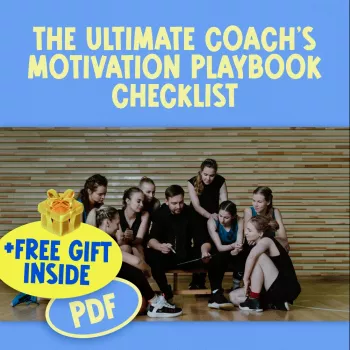
Digital download: The Ultimate Coach’s Motivation Playbook Checklist
If you want the full system in a ready-to-use format, The Ultimate Coach’s Motivation Playbook Checklist (digital download) is designed for coaches who want a practical, repeatable method for energizing players across practices and games. It structures pre-practice preparation, in-session feedback, and post-session reflection so motivation doesn’t depend on mood.
For reset moments in high-pressure stretches, pair it with Breathe Easy: Mindfulness Breathing Action Checklist—a simple routine that supports composure, attention, and “next play” execution.
FAQ
Who is the ultimate coach?
The ultimate coach consistently develops people and performance by setting clear standards, building trust, and holding athletes accountable with a growth mindset. They adapt communication to the athlete while keeping a stable identity, predictable culture, and measurable expectations.












Leave a comment