



Failure-to-Success Quotes: 5-Minute Resilience Routine
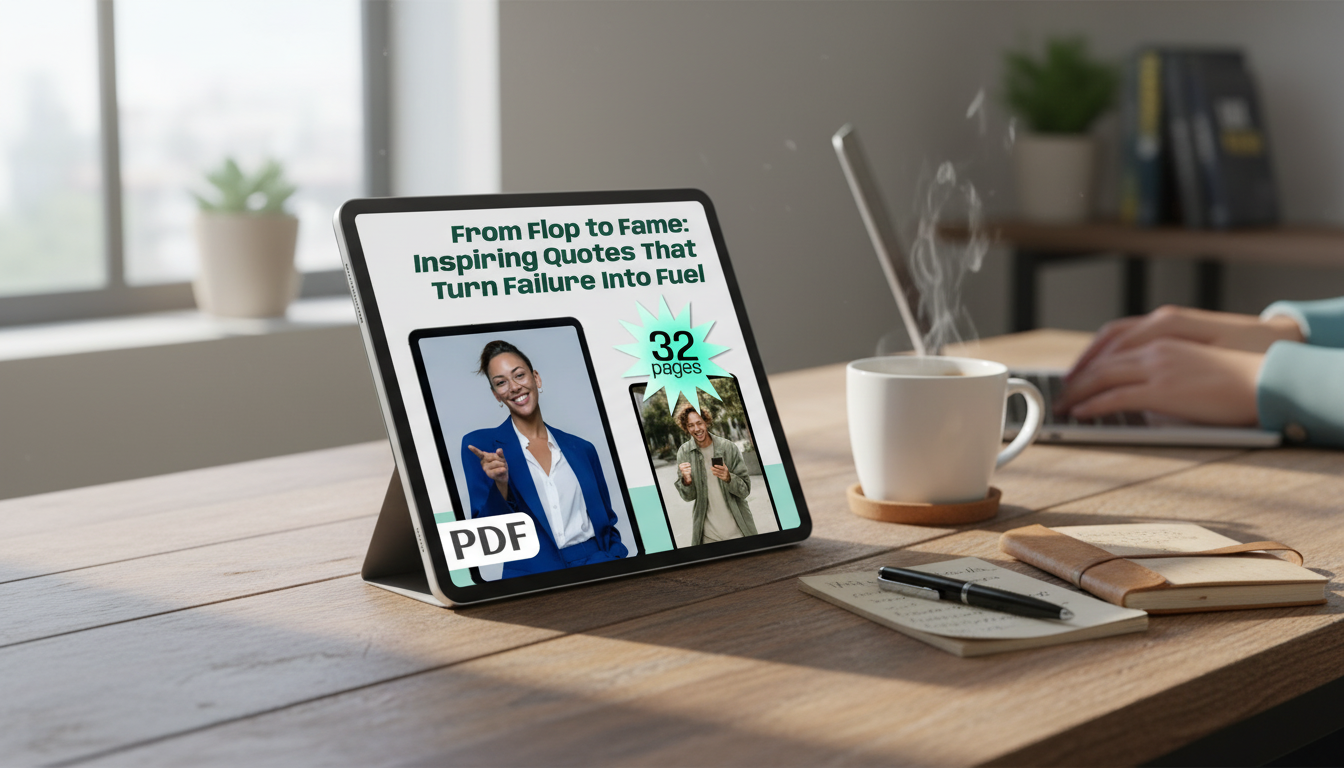
From Flop to Fame: Quotes That Turn Failure Into Fuel
Failure can feel final, but it often acts like feedback—pointing to what needs strengthening, simplifying, or rethinking. A well-timed quote can interrupt spiraling thoughts, replace shame with perspective, and spark the next small action. This guide pairs practical ways to use failure-to-success quotes with a digital eBook designed to build resilience, motivation, and momentum.
Why failure hits so hard (and why it can help)
Setbacks don’t just disappoint; they can trigger a threat response. When the brain reads failure as danger, thinking can narrow into all-or-nothing conclusions, self-criticism spikes, and avoidance starts to look like “being realistic.” That’s why a single misstep can feel larger than it is.
Not all failures mean the same thing, either. A missed sales goal might be a strategy gap (wrong channel or offer), while a bombed presentation might be a skill gap (practice and delivery). Sometimes it’s timing, and sometimes it’s an unclear goal that made success impossible to measure. Treating every setback as proof of inadequacy is a misdiagnosis—and it keeps the fix out of reach.
Reframing failure as data lowers the emotional temperature and brings problem-solving back online. Resources like the American Psychological Association’s overview of resilience highlight how resilient responses can be learned and strengthened over time. Quotes help because they’re short, repeatable, and easy to recall under pressure—like a mental “reset button” that gets you back to your next step.
What makes a quote actually motivating (not just nice words)
Some quotes land because they point somewhere concrete: practice, repetition, courage, or patience. Others are vague encouragement that feels good for five seconds and then evaporates. Motivation sticks better when the message supports a specific behavior.
- Specificity beats hype: lines that encourage action, iteration, or persistence tend to outperform generic positivity.
- Identity-safe language helps: “a failure happened” is workable; “I am a failure” is a dead end.
- Timing matters: reflective quotes work best after you’ve cooled down; direct, action-focused quotes work best right before the next attempt.
- Match the quote to the obstacle: fear of judgment needs different words than burnout or rejection.
Match the moment to the message
| When it feels like… | Use quotes that emphasize… | Next step to pair with it |
|---|---|---|
| A dead end | Experimentation and iteration | List 3 alternative approaches and test one today |
| Embarrassment | Learning over image | Write the lesson in one sentence; share only with a trusted person |
| Rejection | Volume and resilience | Send one more pitch/application/message within 24 hours |
| Not good enough | Practice and growth | Do a 20-minute skill drill; track progress weekly |
| Burnout | Rest and pacing | Schedule a recovery block; resume with a smaller target |
A simple resilience routine using quotes (5 minutes a day)
Quotes work best when they’re not a detour from action. Try this quick routine to turn inspiration into forward motion.
- Step 1: Name the “flop” clearly (one sentence, no drama): what happened and what was expected.
- Step 2: Pick one quote that matches the moment (confidence, patience, persistence, or courage).
- Step 3: Translate the quote into a micro-commitment: one action that takes 5–15 minutes.
- Step 4: Track proof of progress: a checklist, habit tracker, or short reflection to build trust in consistency.
- Step 5: End with self-compassion: treat effort as a skill being trained, not a personality trait.
If you want a deeper framework for learning from setbacks, Harvard Business Review’s guidance on learning from failure is a strong companion to a daily quote-and-action practice.
From Flop to Fame eBook: what the digital guide delivers
When motivation is low, scrolling for “the right words” can become its own form of procrastination. From Flop to Fame: Inspiring Quotes That Turn Failure Into Fuel is built to be fast to open, easy to revisit, and simple to use when you need a steady mental reset.
- A curated collection of failure-to-success quotes selected to support resilience, motivation, and steady action.
- A structured format that makes it easier to return to effective lines during tough moments—without endless searching.
- Useful for students, entrepreneurs, creatives, and career changers rebuilding confidence after setbacks.
- Digital download convenience: keep it on a phone, tablet, or computer for quick access on stressful days.
- Pairs well with journaling, goal-setting, vision boards, or daily affirmations—without requiring long reading sessions.
It also complements a growth-oriented approach: the Stanford-aligned Growth Mindset resource underscores the value of effort, learning, and strategy—exactly the mindset a good quote can reinforce.
Ways to use the quotes when motivation is low
For a small, tangible reminder alongside your routine, consider a wearable cue you can associate with “show up anyway,” like the Vintage Leather Bracelet for Men with Stainless Steel Magnetic Clasp. Pairing a quote with a physical anchor can make the habit easier to recall when you’re distracted or stressed.
Who this guide fits best (and when it might not)
FAQ
How is a digital download eBook delivered after purchase?
After checkout, access is typically provided digitally via a download link or an account/order page. Save the file to your preferred device (phone, tablet, or computer) and keep a backup copy so it’s easy to reopen when you need it.
Can quotes really help with resilience after failure?
Yes—short, repeatable messages can support reframing and motivation, especially when paired with a small action. For example, after a rejection, use a persistence-focused quote and commit to one more outreach message within 24 hours.
What’s a good way to use failure-to-success quotes without relying on hype?
Select a quote that matches the obstacle, write a one-sentence takeaway, and pair it with a specific next step plus a simple tracker (like a checkbox). That combination turns the quote into behavior, not just a mood boost.












Leave a comment