



65W GaN USB-C Charger (QC + PD): One Brick Power
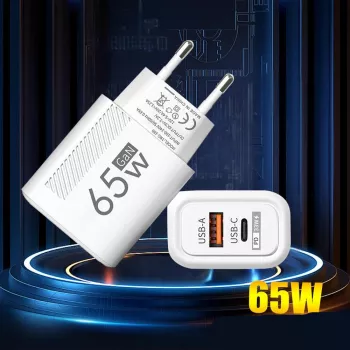
65W GaN USB‑C Fast Wall Charger with Quick Charge: Compact Power for Phones, Tablets, and Laptops
A single small wall charger can cover everyday charging for a phone, tablet, earbuds, and even many USB‑C laptops—if the wattage and protocols match the device. A 65W GaN charger is built for exactly that “one brick” lifestyle: fast enough for modern USB‑C gear, compact enough for travel, and flexible enough for mixed households.
What a 65W GaN wall charger is designed to do
A 65W wall charger is designed to deliver up to 65 watts of power when a connected device can accept it. That’s enough for rapid phone and tablet top-ups, and it can also charge many USB‑C laptops that support USB‑C Power Delivery (USB PD) at 45W–65W.
GaN (gallium nitride) switching components are the reason these chargers often feel “surprisingly small for the power.” GaN designs typically waste less energy as heat than many older silicon designs, which helps manufacturers shrink the enclosure while keeping output high.
This power range is especially practical for people juggling multiple devices—phone + tablet + laptop + accessories—without wanting to pack separate laptop bricks and phone cubes.
GaN vs fast charging: what changes and what doesn’t
It’s easy to mix up “GaN” with “fast charging,” but they’re not the same thing. Fast charging is determined by the charging standard (for example, USB PD or Quick Charge) and the power profiles your device supports. GaN is about the internal technology used to convert wall power into USB power efficiently.
What GaN changes: chargers can be smaller and can run cooler at a given wattage, especially under sustained loads. What GaN doesn’t change: your phone, tablet, or laptop still negotiates power with the charger, and it will only draw what its supported protocol and profile allow.
For modern USB‑C devices, USB PD is the most common pathway to higher wattage. Quick Charge is widely used across many Android ecosystems and is often associated with fast phone charging behavior when the charger and phone agree on a compatible mode.
Quick Charge and USB‑C Power Delivery: compatibility basics
USB‑C Power Delivery (USB PD) is the most universal fast‑charging standard for USB‑C devices, including many tablets, handheld gaming devices, and a wide range of laptops. USB PD negotiates voltage and current over USB‑C, enabling higher power levels when supported. For background, the USB Implementers Forum provides a helpful overview of USB PD here: https://www.usb.org/usb-charger-pd.
Quick Charge (QC) is a family of fast‑charging standards commonly supported by many Android phones. A QC-capable charger can help compatible phones charge faster—when both ends support the same QC generation and behavior. Qualcomm’s technology overview is here: https://www.qualcomm.com/products/features/quick-charge.
When standards don’t match, devices fall back: a phone that doesn’t support QC may charge via USB PD (if available) or standard USB charging. And even when everything is compatible, charging speed naturally tapers as the battery fills—normal lithium-ion behavior explained in resources like Battery University’s charging guide: https://batteryuniversity.com/article/bu-409-charging-lithium-ion.
Don’t overlook the cable. Higher-watt charging typically requires a quality USB‑C to USB‑C cable rated for the needed current (and for some higher tiers, an e‑marked cable). If charging is inconsistent or slow, the cable is often the first thing to swap.
Device matching cheat sheet for a 65W GaN charger
| Device type | What to check | Typical result with 65W |
|---|---|---|
| USB‑C laptop | USB‑C PD support and required wattage | Often charges at full speed if laptop accepts 45–65W PD; higher-watt laptops may charge slower or maintain battery level under load |
| Android phone | Quick Charge and/or USB‑C PD support | Fast charge when the phone and charger share a standard; otherwise standard charging |
| iPhone/iPad | USB‑C PD support (model-dependent) | Fast charge on supported models using USB‑C PD and a quality USB‑C cable |
| Accessories (earbuds, watches, power banks) | Input spec on device or case | Usually charges fine; some very low-power devices may charge slower on certain ports/cables |
Why 65W can replace multiple chargers
Possible drawbacks to know before buying
Product snapshot: 65W GaN USB‑C Fast Wall Charger with Quick Charge
The 65W GaN USB C Fast Wall Charger with Quick Charge is built for modern USB‑C fast charging with support for Quick Charge compatible devices. It’s a strong fit for commuters, travelers, and minimalists who want one compact charger that can cover multiple everyday devices.
Everyday setup tips for faster, safer charging
Also in stock
- Men’s Luxury Chronograph Quartz Watch with Leather Band & Waterproof Features
- Vintage Leather Bracelet for Men with Stainless Steel Magnetic Clasp – Trendy Bangle for Fashion & Parties
FAQ
What are the disadvantages of a GaN charger?
GaN chargers are mainly about size and efficiency, so the biggest tradeoffs are often a higher price than basic chargers and noticeable warmth at high loads. They also don’t guarantee faster charging unless the wattage and fast‑charge protocol match what your device supports.
What is the difference between a fast charger and a GaN charger?
A fast charger is defined by the charging standard and power profiles it supports (such as USB PD or Quick Charge). A GaN charger describes the internal semiconductor technology that helps deliver that power in a smaller, often more efficient design.
What is a GaN USB-C wall charger?
It’s a wall charger that uses GaN components and typically provides USB‑C output with modern fast‑charge negotiation (commonly USB PD). The goal is higher power delivery in a compact form factor for phones, tablets, and many USB‑C laptops.













Leave a comment