



AI Pet Behavior Toolkit (10-in-1) for Calmer Routines
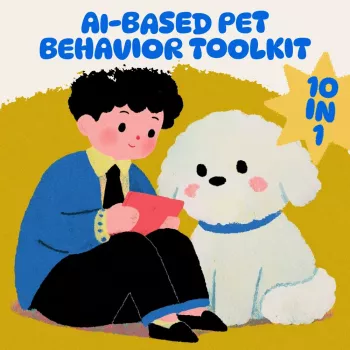
AI-Based Pet Behavior Toolkit for Every Pet Parent (10-in-1): A Clear System for Calmer Days
Everyday behavior challenges—barking, scratching, potty accidents, leash pulling, anxiety, and multi-pet tension—often improve fastest with a clear plan and consistent tracking. The AI-Based Pet Behavior Toolkit for Every Pet Parent – 10-in-1 Bundle of Guides, eBooks & Checklists is a digital toolkit built to help you observe patterns, choose realistic goals, and build better habits at home—without turning daily life into a full-time training program.
Instead of collecting scattered tips from dozens of places, this bundle organizes what matters most: what happened, why it might be happening, what to do next, and how to tell if it’s working.
Who this toolkit is for
- New pet parents who want a step-by-step framework instead of scattered tips
- Busy households that need short routines, clear checklists, and quick decision prompts
- Pet parents managing common issues: jumping, pulling, chewing, scratching, meowing, barking, fearfulness, and separation distress
- Multi-pet homes working on introductions, boundaries, and reducing conflict
- Anyone who wants to document behavior changes to share with a trainer or veterinarian when needed
It’s especially useful when more than one person participates in care—because consistency (same cues, same boundaries, same reward timing) is often the fastest path to improvement.
What’s inside the 10-in-1 bundle
- Guides that break behavior change into observation → hypothesis → plan → reinforcement → review
- eBooks with scenario-based examples (what to do before, during, and after an unwanted behavior)
- Printable and digital-friendly checklists for daily routines, weekly milestones, and progress reviews
- AI-assisted prompts to turn notes into simple action steps (e.g., adjust triggers, timing, rewards, environment)
- Templates for tracking meals, potty schedules, enrichment, sleep, and training sessions in one place
- House rules worksheets to align everyone in the home on cues, boundaries, and reward timing
- Troubleshooting pages that focus on common “why it’s not working yet” moments (inconsistent reinforcement, unclear cues, accidental rewards, too-big goals)
Toolkit components and how they get used
| Component | Best used for | Typical cadence |
|---|---|---|
| Behavior checklists | Keeping routines consistent across family members | Daily |
| Tracking templates | Spotting patterns in triggers, timing, and environment | Daily to weekly |
| Scenario guides | Choosing a response in the moment without escalating stress | As needed |
| Goal planners | Breaking one big issue into small, measurable steps | Weekly |
| Review sheets | Deciding what to keep, change, or simplify | Every 1–2 weeks |
How the AI-assisted workflow supports better habits
- Turns observations into clearer next steps: instead of “my dog is stubborn,” focus on timing, cues, reinforcement, and triggers
- Encourages small experiments: change one variable at a time (distance to trigger, reward value, session length)
- Promotes consistency: repeatable routines reduce confusion and speed up learning
- Helps prevent plateaus by prompting structured reviews and realistic milestones
- Supports calmer households by emphasizing management tools (gates, leashes indoors, enrichment, predictable schedules) alongside training
This workflow is designed to keep your plan realistic. If a strategy depends on perfect timing all day long, it usually collapses under real life. A better approach is a few repeatable “defaults” (management + short skill-building sessions) that you can maintain on busy days.
Common problems the toolkit helps organize
- Noise and attention behaviors: barking, whining, meowing, pawing, demand behaviors
- Destructive habits: chewing, digging, scratching furniture, counter-surfing
- Leash and outdoor challenges: pulling, reactivity at a distance, overstimulation, poor recall foundations
- Household routines: potty training refreshers, feeding manners, crate or safe-space routines
- Fear and stress signals: hiding, trembling, pacing, vocalizing, shutdown behavior
- Multi-pet dynamics: introductions, resource guarding prevention routines, separate feeding plans, calm co-existence scheduling
Instead of treating these as random “bad behaviors,” the toolkit helps you categorize them as skills to teach, environments to adjust, or needs to meet (rest, enrichment, predictability). For humane, evidence-based guidance, many pet parents also reference organizations like AVSAB and practical behavior resources from the ASPCA.
Getting started in 30 minutes
- Pick one priority behavior to tackle first (the one that affects safety, stress, or daily function most).
- Define the behavior in observable terms (e.g., “jumps on guests” vs. “is out of control”).
- Do a quick baseline: when it happens, what happens right before, what happens right after.
- Add one management step for immediate relief (block access, add a leash indoors, increase enrichment, change setup).
- Choose one training micro-goal for the week (e.g., 3 calm greetings per day, 2-minute mat settle practice).
- Set a review date and track only the essentials—consistency beats complexity.
If your household is starting from square one (especially with puppies), pairing this behavior-focused bundle with foundational routines can speed things up. The Step-by-Step Puppy Training Toolkit: A Beginner’s Guide to Dog Training + eBooks & Checklists is a helpful add-on when the main goal is building basics like crate comfort, polite leash skills, and bite-inhibition routines from day one.
Safety notes and when to get professional help
Related resources for puppy foundations
FAQ
How much does an AI pet cost?
Virtual AI pets are often priced as app subscriptions or one-time downloads, while robotic AI pets can cost significantly more due to hardware and sensors. A digital behavior toolkit is typically a one-time purchase for guides and templates, with pricing varying by what’s included.
What is an AI pet?
An AI pet usually refers to a virtual companion in an app or a robotic pet designed to respond to interactions. This toolkit doesn’t replace a real pet—it uses AI-assisted prompts to help you organize observations and keep a real pet’s behavior plan consistent.
How to create an AI pet?
At a high level, creating an AI pet involves choosing a platform (app, game engine, or robot), defining behaviors, and building a conversational or response system with animations or actions. For most pet parents, a practical alternative is using AI-assisted planning to improve real-pet behavior through routines, tracking, and reinforcement.














Leave a comment