



Biweekly Budgeting: A 14-Day Plan to Save More

Why a biweekly plan works when monthly budgets don’t
A monthly budget can feel like one long, blurry stretch—especially when most people actually get paid every two weeks. A biweekly plan tightens the feedback loop. Instead of waiting until the last few days of the month to realize spending drifted, you get a “reset point” every 14 days to course-correct.
This rhythm also makes saving feel less intimidating. Moving smaller amounts every paycheck is often easier than trying to find a big chunk once a month. It’s also simpler to automate: one transfer on payday, every payday.
Another advantage is cash-flow comfort. When bills are split between Paycheck A and Paycheck B, you avoid the all-at-once crunch that can happen when multiple due dates collide. And because planning and reviewing are closer together, tracking improves—there’s less time for receipts, subscriptions, and quick purchases to disappear into the background.
Set up your two-week money map in 30 minutes
Think of this as a simple map that gives every paycheck a job before you spend it. You don’t need perfection; you need a repeatable template you can run on autopilot.
1) Lock in pay dates and real take-home pay
Write down your exact pay dates for the next 2–3 months and your typical take-home amount. If your paycheck varies due to overtime, commissions, or taxes, base the plan on a conservative “floor” number and treat anything above that as extra savings or faster debt payoff. If you’re unsure whether withholding changes could help your take-home planning, the IRS Tax Withholding Estimator can clarify what to expect.
2) Build four buckets
Create four categories you’ll use every cycle:
- Essentials: housing, utilities, groceries, basic transport
- Financial goals: debt payoff, emergency fund, investing
- True expenses: annual/quarterly bills, car maintenance, gifts
- Lifestyle: dining out, hobbies, non-essentials
3) Separate fixed vs. variable costs
Fixed bills are predictable (rent, insurance). Variable costs (groceries, utilities) should be estimated conservatively so the plan doesn’t break mid-cycle.
4) Choose a default savings move
Decide what happens automatically each payday—example: a fixed transfer to an emergency fund plus a smaller transfer to a sinking fund for true expenses. The key is consistency, even if you start small.
5) Pick one tracking method and keep it for a month
Use a spreadsheet, a budgeting app, or a printed checklist. Stick to one system for a full month before switching so you’re improving the routine instead of constantly rebuilding it.
The biweekly budgeting checklist (payday to payday)
This is the repeatable 14-day cadence that turns “budgeting” into a quick process instead of a weekend project.
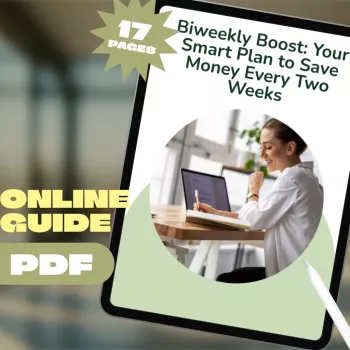
If you want a ready-made structure you can reuse every paycheck, Biweekly Boost: Your Smart Plan to Save Money Every Two Weeks (digital guide and checklist) is designed around this exact payday-to-payday flow.
Split bills by paycheck to avoid surprises
For common monthly bills, many households smooth cash flow by paying some in the first cycle (rent/mortgage, insurance) and others in the second cycle (utilities, subscriptions). For annual or irregular bills—registrations, memberships, holiday gifts—divide the total by the number of paychecks until it’s due and automate that amount into a separate fund. The Consumer Financial Protection Bureau (CFPB) has practical resources on budgeting and cash flow that pair well with this approach.
Two-week plan example: what to do each payday
| Cycle step | Paycheck A (Week 1) | Paycheck B (Week 3) |
|---|---|---|
| Essentials first | Pay housing + insurance; set grocery limit | Pay utilities + transport costs; restock groceries |
| Savings transfer | Move fixed amount to emergency fund | Move fixed amount to sinking funds (car, holidays, annual bills) |
| Debt strategy | Minimums + extra on highest-interest debt | Minimums + extra on target debt (or snowball next balance) |
| Spending guardrails | Set a small “flex” amount for wants | Adjust flex based on mid-cycle check results |
| Review | Quick check on Day 7 | Full review on Day 14 before next payday |
How to find extra money every two weeks (without extreme cuts)
If you want a solid foundation for building healthier money habits without adding stress, the FDIC Money Smart program is a reliable free education resource.
Make it stick: automation and a simple scorecard
Spending can also be emotional and environment-driven. If clutter or overwhelm tends to trigger impulse shopping, Clear Space, Clear Mind: decluttering guide to reduce overwhelm and spending triggers pairs well with a biweekly budget by making “pause and plan” feel easier at home.
A ready-to-use digital guide and checklist for biweekly budgeting
A checklist-based plan removes guesswork by turning each paycheck into the same set of steps: pay what’s due, fund savings, set guardrails, and review quickly. If you’d rather not build spreadsheets from scratch, Biweekly Boost: Your Smart Plan to Save Money Every Two Weeks (digital guide and checklist) is a reusable digital routine you can follow every cycle—and print if paper works better.
For staying calm and consistent during money check-ins (especially if budgeting feels stressful), Breathe Easy: Your Mindfulness Breathing Action Checklist can support a quick reset before you review accounts or make spending decisions.
FAQ
How to save $10,000 in 3 months biweekly?
Divide $10,000 by the number of biweekly paychecks in three months (typically 6), which is about $1,667 per paycheck, then move that amount to a separate savings account on payday. To make it realistic, split bills tightly, cut discretionary spending aggressively for one quarter, and add temporary income boosts; depending on the calendar, you may have 7 paychecks, which lowers the per-paycheck target.












Leave a comment