



Gentle Motivation for Enneagram 9: Peaceful Checklist

Gentle Motivation for Enneagram Type 9: A Checklist That Protects Your Peace
Enneagram Type 9s often do best with motivation that feels safe, steady, and choice-based—rather than urgent or forceful. When the nervous system senses pressure, it can be tempting to go quiet, go numb, or go along with someone else’s priorities just to keep things smooth. A calm checklist approach helps you create low-pressure momentum: small steps that compound over time, without sacrificing your inner peace.
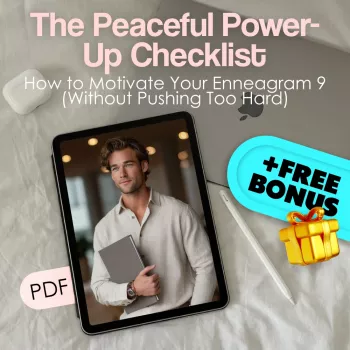
If you like the idea of a ready-to-use, printable-style structure, you may also enjoy The Peaceful Power-Up Checklist: How to Motivate Your Enneagram 9 (Without Pushing Too Hard), a digital download designed around gentle follow-through.
Why Type 9 Motivation Works Best When It’s Calm and Consent-Based
Type 9s tend to move when the path feels harmonious, clear, and non-threatening. That isn’t laziness—it’s a sensitivity to inner stability. When motivation comes with sharp edges (pressure, conflict, or a “no excuses” tone), many 9s don’t feel energized; they feel braced.
- Pressure or aggressive accountability can trigger shutdown, avoidance, or quiet resentment.
- Gentle structure supports action without disrupting emotional equilibrium.
- The goal is sustainable movement—small steps that compound—rather than short bursts of intensity.
For a helpful baseline on Type 9 patterns, the Enneagram Institute’s Type Nine overview offers a clear summary of core motivations and stress responses.
Common Motivation Blocks for Enneagram 9 (and What They’re Really Protecting)
Many Type 9 “blocks” are actually protective strategies. They reduce internal friction, prevent conflict, or preserve comfort—until they start costing you your own priorities.
- Merging with others’ priorities: saying yes to keep peace, then losing track of personal goals.
- Decision fatigue: too many options can feel like conflict, so nothing gets chosen.
- Comfort-trap routines: familiar rhythms provide safety, even when they limit growth.
- Invisible anger: unspoken frustration drains energy and makes tasks feel heavier.
- Fear of disruption: progress requires change, and change can feel like instability.
Procrastination is also deeply tied to emotion regulation—not just time management. The American Psychological Association’s overview on procrastination explains how avoidance can temporarily reduce stress, even when it creates bigger stress later.
The Peaceful Power-Up Method: A Low-Pressure Sequence for Getting Unstuck
When motivation feels far away, “trying harder” often backfires for Type 9. A better route is a sequence that lowers resistance first, then builds momentum.
- Start with body-based cues: water, a snack, a stretch, or a short walk can unlock movement faster than willpower.
- Name one priority: choose the smallest meaningful target for today (not the ideal version of today).
- Reduce friction: set up the environment so the first step takes under two minutes.
- Use a “soft start”: pick a warm-up task (open the document, gather supplies, set a timer) to ease into action.
- Close the loop: create a tiny finish line so your system registers completion and safety.
If stress or scattered attention is part of what keeps you stuck, pairing this method with a short breathing routine can help you start with a steadier baseline. A simple option is Breathe Easy: Your Mindfulness Breathing Action Checklist.
Checklist Prompts That Motivate Type 9 Without Pushing Too Hard
Type 9s often respond well to prompts that feel kind, specific, and autonomy-friendly. These are designed to invite action without triggering inner resistance.
- Permission prompt: “What would feel kind and doable right now?”
- Clarity prompt: “What’s the next right step—small enough to do even on a low-energy day?”
- Boundary prompt: “What needs to be a ‘not today’ so this can be a ‘yes’?”
- Connection prompt: “Who benefits when this gets done (including future me)?”
- Anti-perfection prompt: “What would a 70% version look like?”
Gentle Motivation Prompts for Type 9
| Situation | What It Can Feel Like | A Calm Prompt to Use |
|---|---|---|
| Avoiding a task | “It’s too much; I’ll do it later.” | “What’s the smallest piece I can do in 5 minutes?” |
| Too many choices | “I don’t know what to pick.” | “Which option reduces stress the most this week?” |
| Low energy day | “I can’t get started.” | “What’s one comfort-supporting action that also moves this forward?” |
| People-pleasing pull | “Their needs come first.” | “What do I need to feel steady and show up well?” |
| Quiet resentment | “I’m fine.” (but not really) | “What boundary would prevent this from building again?” |
How to Use a Digital Checklist So It Actually Gets Used
The best checklist is the one you’ll return to when you’re tired, distracted, or emotionally overloaded. For Type 9, “easy to return” matters as much as “well designed.”
- Pick one home: phone notes app, tablet, printed page, or a pinned PDF—avoid scattering versions.
- Pair it with an existing routine: morning tea, lunch break, or an end-of-day shutdown ritual.
- Limit the daily goal: one meaningful task plus one supportive task (intentional rest counts).
- Track consistency, not intensity: repeatable effort builds trust faster than occasional big pushes.
- Add a closing ritual: a 10-second acknowledgment (“done for today”) helps your system feel completion.
If your motivation dips when your environment feels visually noisy, a gentle decluttering guide can be a supportive companion. Consider Clear Space, Clear Mind: How to Find Motivation and Declutter Your Home for Good for calm, step-by-step progress.
When Motivation Still Doesn’t Show Up: A Compassionate Troubleshooting Flow
Sometimes the issue isn’t discipline—it’s that your system is protecting you from something that feels unsafe. Instead of forcing momentum, try a smaller, kinder adjustment.
A Simple Weekly Rhythm for Type 9: Steady Progress Without Pressure
FAQ
What does power to the peaceful mean?
It means strength expressed through calm steadiness—choosing grounded action without aggression. It’s protecting your inner peace while still advocating for your needs, priorities, and boundaries.









Leave a comment