



Mindfulness for Anxiety: Fast Calm Tools & Daily Routine

Taming the Storm Within: A Practical Guide to Calming Anxiety Through Mindfulness
Anxiety can show up as racing thoughts, tightness in the chest, restless sleep, and a constant feeling of being “on edge.” Calming it often works best with a practical toolkit: quick techniques for acute moments, daily habits that reduce baseline stress, and a clear plan for tracking progress. Mindfulness isn’t about forcing your mind to go blank—it’s about training attention and building steadiness so anxious waves feel more manageable.
What Anxiety Can Feel Like (and Why It Can Be So Intense)
Anxiety is more than “worry.” It can include worry loops, irritability, muscle tension, rapid heartbeat, stomach discomfort, trouble concentrating, and sleep disruption. When it hits, it can feel urgent and convincing—like something must be solved immediately.
Part of the intensity comes from the body’s threat system (fight/flight). Sometimes it misfires and treats uncertainty like danger, sending stress signals through your body even when there’s no immediate threat.
A common pattern is the anxiety cycle: trigger → anxious thoughts → body sensations → avoidance or safety behaviors → short-term relief → stronger anxiety next time. Avoidance “works” briefly, but it teaches the brain the situation was dangerous, making the alarm louder later.
If symptoms persist for weeks, interfere with work or relationships, involve panic attacks, or include thoughts of self-harm, it’s time to seek extra support. For urgent crisis help, contact local emergency services or a crisis line right away. For more background on anxiety disorders, see the National Institute of Mental Health and the American Psychological Association.
Fast Calming Tools for the Moment Anxiety Spikes
When anxiety surges, the goal is to reduce physiological arousal and interrupt rumination—fast. These tools are simple, but they work best when practiced during calmer times.
Breathing reset (long-exhale focus)
For 2–3 minutes, breathe in gently and exhale slightly longer than you inhale. A longer exhale nudges the nervous system toward “safe,” lowering arousal.
5-4-3-2-1 grounding
Name 5 things you see, 4 you feel, 3 you hear, 2 you smell, and 1 you taste. This redirects attention from “what if” thoughts to direct sensory input.
Name the experience
Try labeling: “Anxiety is here” and “Tight chest.” This creates distance from the thought stream, turning a swirl into something you can observe.
Progressive muscle relaxation
Tense a muscle group for 5 seconds, release for 10 seconds. Move through shoulders, hands, jaw, legs. Releasing tension sends a strong safety signal to the body.
Micro-movement
Take a 5–10 minute walk or do gentle stretching. Movement helps metabolize stress hormones and gives your mind a concrete focus.
Mindfulness That Works for Anxious Minds (Without Forcing a “Blank” Head)
Mindfulness works best when the goal is noticing—not erasing—thoughts and sensations. An anxious mind will generate noise; the skill is returning, again and again, to something steady.
If focusing on the breath feels activating, use another anchor: feet on the floor, sounds in the room, hands around a warm mug, slow counting, or a brief body scan.
Try treating thoughts as events. When worry appears, silently note what it’s doing: “planning,” “predicting,” “catastrophizing.” Then return to your anchor without arguing with the thought.
A Simple Daily Plan to Lower Baseline Anxiety
Morning (5–10 minutes)
Midday (2 minutes)
Evening (10–20 minutes)
Sleep support
“Worry container”
Calming Techniques at a Glance
| Situation | What to Try | Time Needed | Helpful Tip |
|---|---|---|---|
| Racing heart / shaky body | Long-exhale breathing or progressive muscle relaxation | 2–5 min | Aim for slower exhale; relax shoulders on each exhale |
| Racing thoughts / spiraling predictions | Labeling thoughts + 5-4-3-2-1 grounding | 2–4 min | Name the pattern (“catastrophizing”) and return to senses |
| Panic rising quickly | Cold water splash + paced breathing + grounding | 3–8 min | Use temperature change as a reset, then steady the breath |
| Avoiding tasks because of worry | Two-minute start + tiny next step | 2–10 min | Commit only to starting; momentum reduces avoidance |
| Nighttime worry | Worry list + calming wind-down routine | 10–20 min | Write worries and one next action; then shift to a calming activity |
Building Your Personal “Calm Kit” (So You’re Not Guessing in the Moment)
A Guided Resource for Mindfulness and Mental Wellness
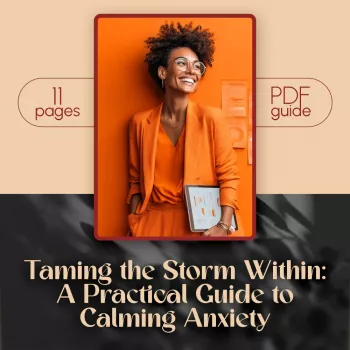
If you want a structured, repeatable routine with step-by-step practices, a dedicated guide can help turn coping skills into consistent habits. Taming the Storm Within: A Practical Guide to Calming Anxiety is designed to make mindfulness feel practical—especially when anxiety makes long practices feel unrealistic.
Some people also find it helpful to support overall stress reduction by simplifying adjacent routines (like getting ready in the morning) or using structured checklists for time-consuming tasks. If that approach fits your life, consider resources like Low-Effort Makeup Secrets Pack for streamlined daily routines, or Step-by-Step Puppy Training Toolkit if household stress is tied to a new dog and you want a clearer plan.
FAQ
What is the fastest way to calm anxiety right now?
Try a quick sequence: long-exhale breathing for 2 minutes, then 5-4-3-2-1 grounding, and finish by relaxing your shoulders and jaw. Repeat once if needed, and practice when calm so it’s easier to access when anxious.
Does mindfulness help with anxiety if thoughts won’t stop?
Yes—mindfulness is noticing thoughts and returning to an anchor, not stopping thoughts. Start with 3–7 minutes, label the mind’s activity (like “predicting” or “catastrophizing”), and gently return attention to your chosen anchor.
When should anxiety be treated by a professional?
Seek professional support if anxiety persists for weeks, interferes with daily life, includes panic attacks, or overlaps with depression, substance use, or feeling unsafe. If there are thoughts of self-harm or immediate danger, get urgent help right away.













Leave a comment